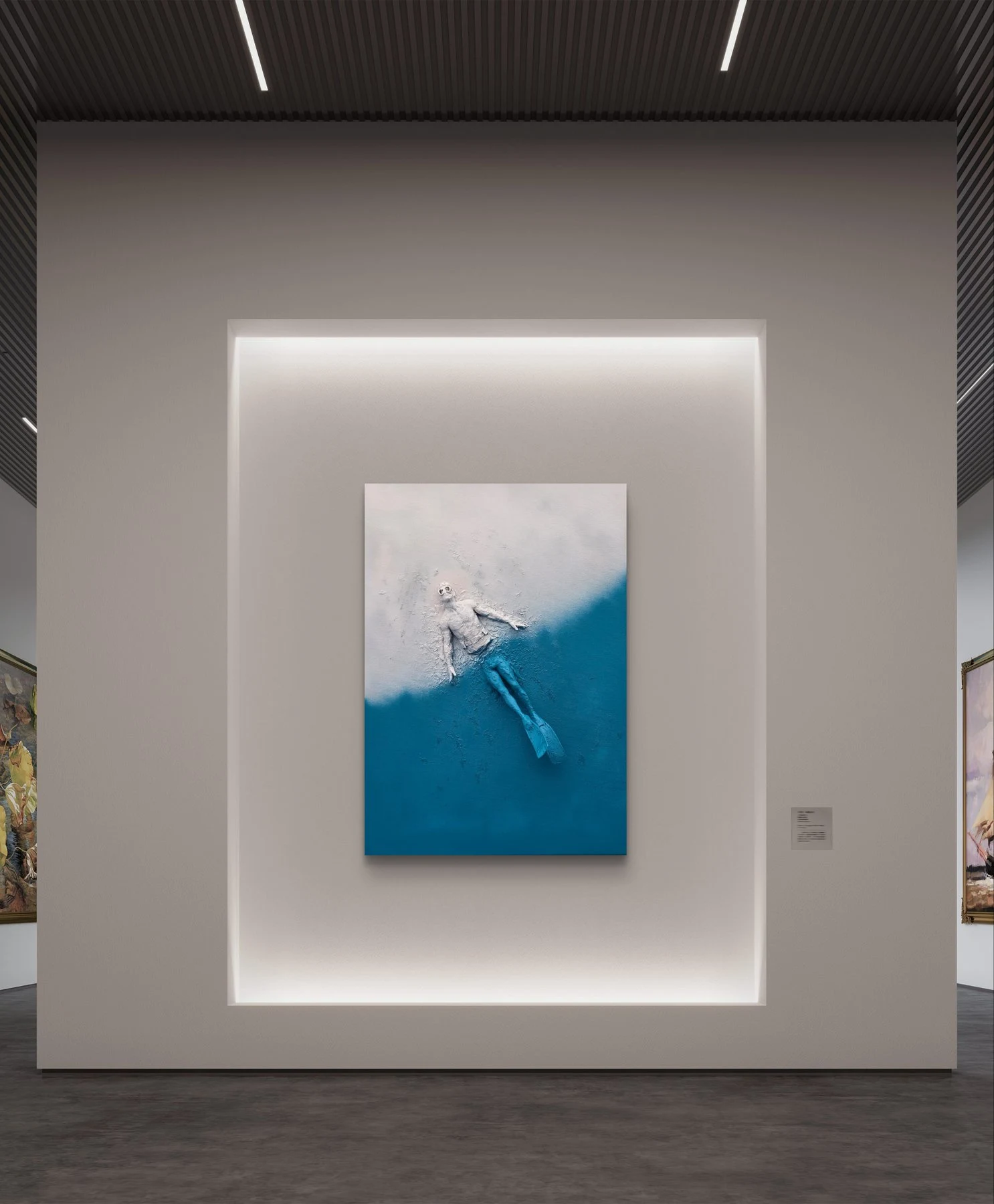
Altijd boven blijven (>2020) by Nicole Lubbers
Add a touch of inspiration to your space with Nicole Lubbers’ “Altijd Boven Blijven.” This vibrant, abstract artwork embodies resilience and strength, featuring dynamic colors and bold forms. Perfect for contemporary settings, it transforms any room into a statement of enduring elegance.
About This Artwork
Transform your space with Nicole Lubbers' “Altijd Boven Blijven,” a mesmerizing abstract piece that celebrates the power of resilience and upward motion. Lubbers, known for her innovative approach to abstract art, utilizes a striking palette and dynamic forms to create a compelling visual narrative.
The artwork's rich colors and intricate textures draw viewers in, encouraging them to reflect on themes of perseverance and strength. The piece's bold composition makes it an ideal focal point for a variety of settings, from modern living rooms to chic offices and sophisticated galleries.
“Altijd Boven Blijven” is more than just a work of art—it’s a powerful statement of enduring elegance and the pursuit of greatness. Embrace the energy and inspiration it brings to your space and let it serve as a constant reminder of the beauty in overcoming challenges.
You May Also Like

Delfts
Delfts by Nicole Lubbers is a luminous orchestration of Delft-blue hues and porcelain whites, distilling the elegance of centuries-old ceramic tradition into a crisp contemporary vision. Cool tonal fields glide across the surface, punctuated by refined linework and tile-like intervals that invite the eye to wander. Glaze-like transparencies pool and recede against saturated cobalt passages, while measured negative space gives the composition an airy, architectural poise. The result is a rhythmic interplay of precision and softness that feels both timeless and distinctly modern.Lubbers’ craftsmanship reveals itself in her disciplined layering and deft control of edge, opacity, and tempo. She calibrates each passage to catch and release light throughout the day, balancing velvety depths with translucent veils that echo the optical richness of fired glaze while remaining unequivocally painterly. Rooted in Dutch heritage yet articulated through contemporary abstraction, Delfts reframes familiar iconography to speak to today’s design-minded collector—offering a thoughtful dialogue between craft, culture, and form. In sophisticated interiors, its cool palette harmonizes effortlessly with marble, oak, and steel, making it a serene focal point for minimalist lofts, curated living rooms, or gallery-style corridors. For seasoned collectors, Delfts delivers both aesthetic clarity and conceptual resonance, a refined statement piece that bridges heritage and innovation.

Paysage abstrait en bleu et rouge (1989)
A luminous and evocative lithograph by Zao Wou-Ki, Paysage abstrait en bleu et rouge beautifully captures the interplay of colour, light, and space that defines the artist’s mature abstract style. Created in 1989, this original lithograph is signed in pencil by the artist and comes from a limited edition of only 75 impressions. Medium & Support: Original lithograph on Vélin Arches paper (71/75) Sight size: approx. 60 × 47 cm Framed in gilt moulding: approx. 77 × 65 cm overall Catalogue Reference: Agerup #338 Condition: Excellent — the print is extremely well preserved; the frame shows only minor wear. Why This Piece Matters Artistic Mastery: The work exemplifies Zao Wou-Ki’s renowned balance between Eastern calligraphic tradition and Western lyrical abstraction. The deep blues and fiery reds create an atmospheric composition that bridges cultures. Rarity: Limited to 75 copies, this edition is increasingly hard to find on the secondary market. Prestige: Zao Wou-Ki is one of the most celebrated Chinese-French painters of the 20th century, with works held in leading institutions and consistently achieving record results at major auctions. Special Note for Asian Collectors Zao Wou-Ki holds a particularly strong resonance in China, Hong Kong, and Taiwan, where his works frequently headline major auctions at Christie’s and Sotheby’s. The demand for signed limited-edition lithographs has grown significantly as collectors seek more accessible entry points into his market while larger canvases achieve multi-million-dollar results. For collectors in Asia: This piece offers an excellent balance of affordability and rarity, making it an ideal addition for both seasoned investors and emerging collectors. Its compact format makes it suitable for private collections or corporate art spaces in Asia’s dynamic markets. Secure international shipping and documentation of authenticity ensure ease of acquisition.
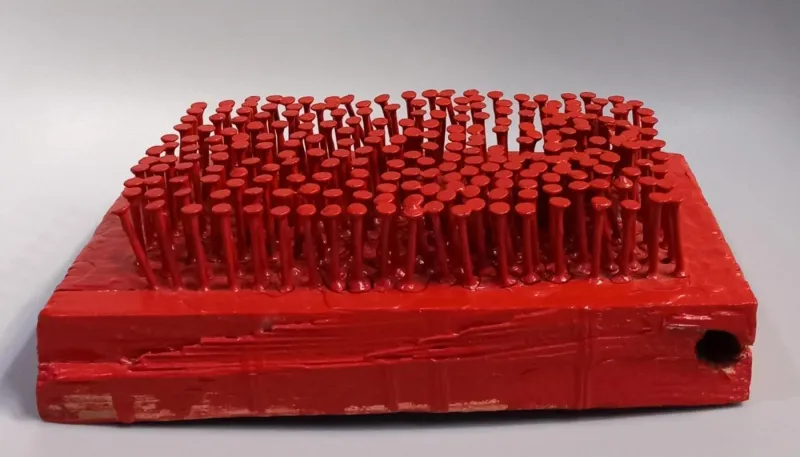
Tableau Clous (1961)
A dense monochrome field of saturated red is punctuated by an ordered constellation of iron nails, their heads articulating a low relief that animates the surface with measured rhythm and light. Driven at regular intervals across the support, the clous transform the painting into a tactile matrix: metallic highlights flare and recede against the red ground, while the physical penetration of the nails compresses and stresses the plane, converting color into structure. Aubertin’s calibrated spacing and depth produce a vibratory optical effect—an austere but sensorial choreography in which repetition, seriality, and the elemental force of red cohere into a rigorously constructed relief painting.Created in 1961, this Tableau Clous is an early-period work from the moment Aubertin expanded his Tableaux Rouges into relief and action, aligning with the ZERO movement’s postwar reset toward clarity and phenomena. In dialogue with contemporaries exploring monochrome and material processes (from Yves Klein’s chromatic absolutism to the serial reliefs that define ZERO’s vocabulary), Aubertin’s nails enact a zero-degree of painting: gesture yields to procedure, and light, surface, and time become the true agents of form—a position that presages his Combustions and fire paintings while retaining the disciplined intensity of Minimal Art. Documented under the archival reference TCLR16-1000395423 and emerging from a Private Collection in Italy, the work bears strong provenance and scholarly traceability; works from this cycle have been contextualized in international museum surveys of ZERO and are present in public collections. For collectors, an early 1961 nail painting represents a significant example from the artist’s definitive period and a museum-grade acquisition within the canon of European avant-garde relief and monochrome. An elemental monochrome animated by serial relief, the work crystallizes Aubertin’s zero-degree painting at the moment of its emergence.